




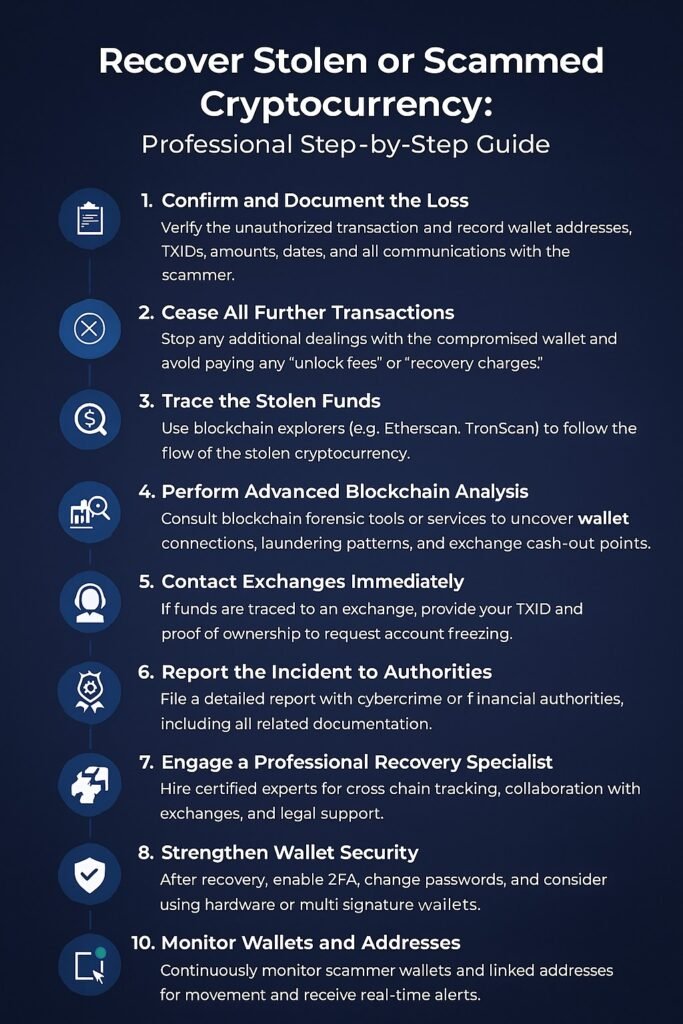
Recover Stolen or Scammed Cryptocurrency: Professional Step-by-Step Guide
Recovering stolen or scammed cryptocurrency requires precision, speed, and expert handling. Here’s a comprehensive approach to maximize your chances of getting your funds back.
Step 1: Confirm and Document the Loss
Verify the transaction and confirm that it was unauthorized or fraudulent.
Record essential details:
Wallet address (sender and recipient)
Transaction ID (TXID)
Amount and type of cryptocurrency
Date and time of the transaction
Any messages, emails, or communications with the scammer
Proper documentation ensures legitimacy for exchanges, authorities, and recovery specialists.
Step 2: Cease All Further Transactions
Immediately stop any additional transactions involving the compromised wallet.
Avoid paying any “unlock fees,” “recovery fees,” or promises of guaranteed returns. Scammers often attempt multiple rounds of fraud.
Step 3: Trace the Stolen Funds
Use blockchain explorers relevant to the stolen crypto:
Bitcoin: blockchain.com, Blockstream
Ethereum: Etherscan
Tron: TronScan
Other chains: Use chain-specific explorers
Track the flow of funds from the scammer’s wallet to identify:
Exchanges where funds may have been sent
Active wallets associated with the scam
Any patterns in movement
Step 4: Perform Advanced Blockchain Analysis
For complex cases, consult blockchain forensic tools or professional recovery services.
Analysis can reveal:
Interconnected wallets
Cross-chain transfers
Suspicious mixing or laundering patterns
Potential cash-out points on exchanges
This information is crucial for law enforcement or exchange intervention.
Step 5: Contact Exchanges Immediately
If the stolen funds are traced to a known exchange:
Provide your TXID, scammer’s wallet address, and proof of ownership.
Request the freezing of the account before funds are withdrawn.
Exchanges can often assist, especially if the scammer has not yet converted the cryptocurrency to fiat.
Step 6: Report the Incident to Authorities
File a report with your local cybercrime division, financial regulatory body, or law enforcement agency.
Include all documented evidence: wallet addresses, transaction IDs, communications, and website/platform information.
Many authorities have specialized units for cryptocurrency fraud.
Step 7: Engage a Professional Crypto Recovery Specialist
Certified recovery experts can provide:
Cross-chain tracking of stolen funds
Collaboration with exchanges and authorities
Forensic investigation to locate hidden wallets
Legal and technical support for recovery cases
A structured recovery plan increases your chances of retrieving funds quickly.
Step 8: Strengthen Wallet Security
After the recovery attempt, secure your cryptocurrency:
Enable two-factor authentication (2FA) on all wallets and exchanges
Use hardware wallets or multi-signature wallets
Change passwords on all related accounts
Avoid phishing links, suspicious emails, and unverified apps
Step 9: Monitor Wallets and Addresses
Continuously track the scammer’s wallet and any linked addresses.
Use alerts from blockchain explorers or tracking tools for real-time notifications.
Early detection of fund movement can facilitate quicker action from authorities or recovery services.
Step 10: Prevent Future Scams
Educate yourself about phishing, social engineering, and fake investment schemes.
Only use verified exchanges and wallets.
Consider professional crypto insurance or secure custodial services for high-value holdings.
1. Identify the Transaction
Locate the exact transaction where the crypto was sent. Copy the TXID/Hash, wallet address, date, and amount. This is the foundation for tracing any stolen funds.2. Stop All Further Transfers
Do not send more funds to the scammer. Avoid any “unlocking fee,” “upgrade fee,” or “KYC charge.” Scammers often try to take more.3. Gather All Evidence
Collect screenshots, messages, emails, website links, wallet addresses, and any suspicious communication. This helps with verification and filing reports.4. Trace the Wallet Address
Use blockchain explorers (such as Etherscan, Blockchain.com, or TronScan) to follow the movement of the stolen assets. This shows where the funds moved next and whether the wallet is still active.5. Run a Blockchain Analysis Check
If available, use or consult professional tracing tools to:Track linked wallets
Detect exchanges involved
Identify patterns in movement
Flag high‑risk addresses
6. Contact the Receiving Exchange
If the funds landed in a known exchange, contact that platform immediately with:Your TXID
Scammer address
Timeline of events
Proof of ownership
Exchanges can freeze accounts if the funds haven’t been withdrawn yet.
7. Report the Scam to Authorities
Submit a report to your local cybercrime unit or financial crime division. Provide:Wallet information
Transaction details
Screenshots and proof
Scammer platform or website
This helps with official tracing and recovery requests.
8. Use a Crypto Recovery Specialist
For advanced recovery, professionals can:Track cross‑chain transfers
Identify hidden wallet movements
Alert exchanges
Prepare case files for law enforcement
9. Secure Your Wallet Going Forward
Update passwords, enable 2FA, remove unknown apps, and avoid suspicious links. Strengthening security prevents future attacks.10. Monitor Wallet Activity
Keep checking the scam wallet and linked addresses. Many scammers move funds slowly—catching early movements increases recovery chances.
- How to Recover Crypto After a Scam or Wrong Transfer
- Best Methods to Recover Lost Bitcoin and Other Cryptos
📞 Contact Crypto Fund Tracker
Website: https://cryptofundstracker.com
Hotline: +1 (786) 969-7027
Whatsapp +1 423 330-2166
Email: Support@cryptofundstracker.com
Office: 2 S Biscayne Blvd #3200, Miami, FL 33131